In his preface to this thoroughly updated book, the author observes that the restitution wars have continued unabated since the publication of the second edition of this work in 2017. The author demonstrates that the law of restitution constitutes a variety of fundamentally distinct gap-filling principles, which cannot be forced into a single and uniform principle such as “unjust enrichment at the plaintiff’s expense”. The results of the attempt to do so are uncertainty and unpredictability, misuse of ordinary and legal language, the creation of new legal fictions, strained reasoning that treats disparate cases as though they were alike, and an abandonment of the inductive empiricism of the common law. Thomas Prince observed of the second edition in Bar News that “[t]he book is well written and easy to read … it is an insightful and intelligent work that is essential reading for those interested in the law of restitution.” Moreover, the historically informed rigour of Jackman’s analysis will deepen any reader’s understanding of the method of doctrinal development under the common law. The Varieties of Restitution is an invaluable resource for all those who seek to understand, or who need to apply, the laws of restitution.
Shop
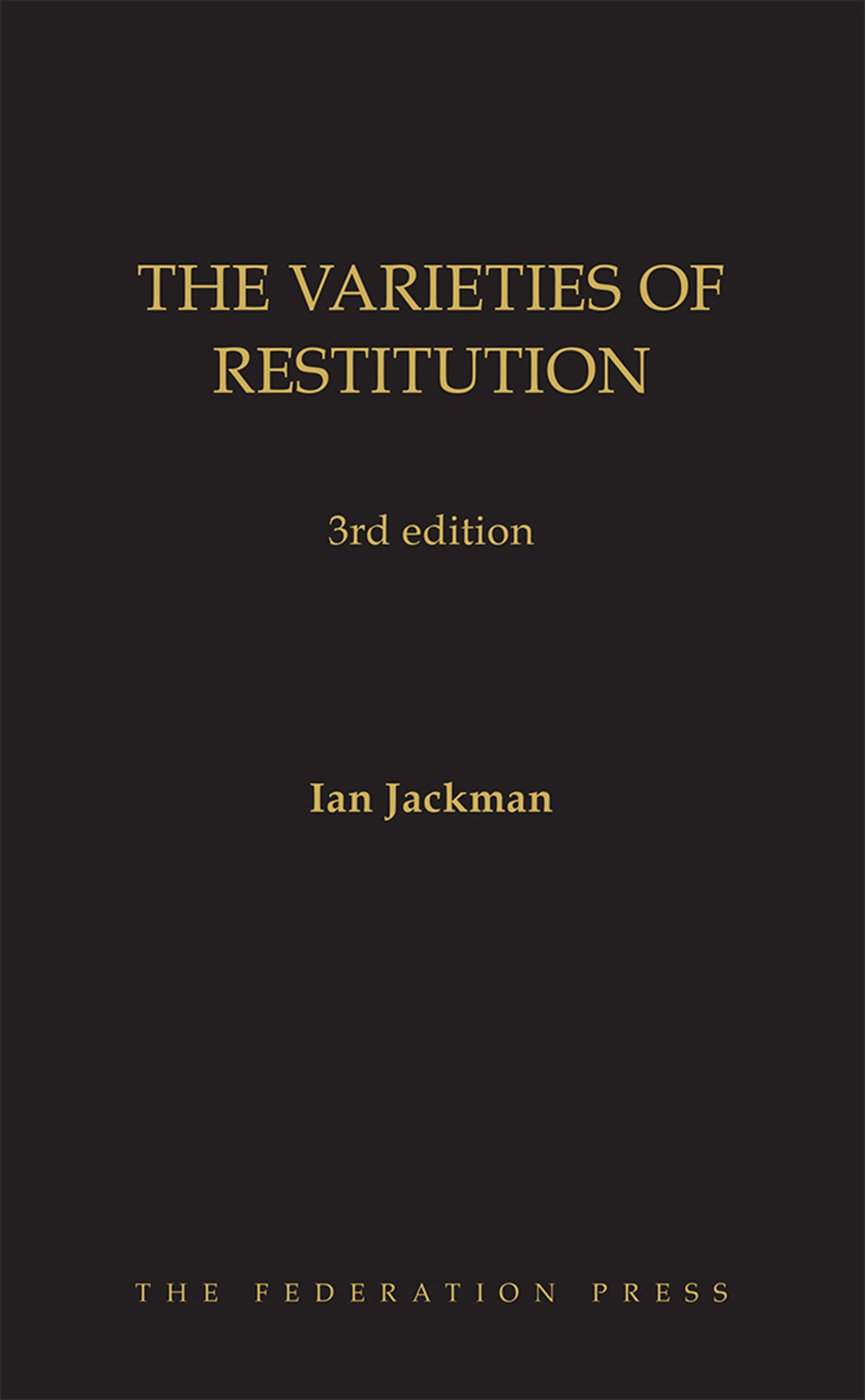
The Varieties of Restitution
3rd edition
| Author | |
|---|---|
| ISBN | 9781760026011 |
| Publication Date | 15/08/2026 |
| Format | Cloth |
AUD $180.00 gst included
Preface
Abbreviations
Table of Cases
Table of Statutes
1. Introduction
2. The History of Restitution and Why It Matters
3. Mistaken Payments
4. Duress, Undue Influence and Unconscionable Dealing
5. Payments Made on a Total Failure of Consideration
6. Voluntary Provision of Benefits in Kind
7. Non-Voluntary Provision of Benefits in Kind
8. Restitution for Wrongs
9. Proprietary Claims and Proprietary Remedies
10. Defences
Index
Reviews of previous editions
Tom Prince, Bar News, NSW Bar Association, Spring 2017Almost two decades have passed since the publication of the first edition of this fine book. During that time the landscape
of the law of restitution in Australia has substantially changed. The publication of a second edition has been long awaited.
The principal argument of the book
is unchanged. It is that, contrary to
the position adopted in England, the
law of restitution cannot be explained
by reference to the unifying principle
of reversing ‘unjust enrichment at the plaintiff’s expense’. The author then
goes on to argue that there are three ‘varieties’ of restitution involving different conceptions of injustice. …
The book is well written and easy to
read … it is an insightful and intelligent work that is essential reading for those interested in the law of restitution. It is to be hoped that the next edition does not take another two decades.